PROJECT DELIVERY
How AI Is Changing Project Delivery
AI is helping project teams turn complex programme data into clearer insights, faster workflows and better-informed decisions that benefit projects.

Author
Jake Barclay

AI is moving beyond experimentation
For several years, AI has largely been discussed as something that could eventually transform project delivery.
That transformation is now beginning to happen.
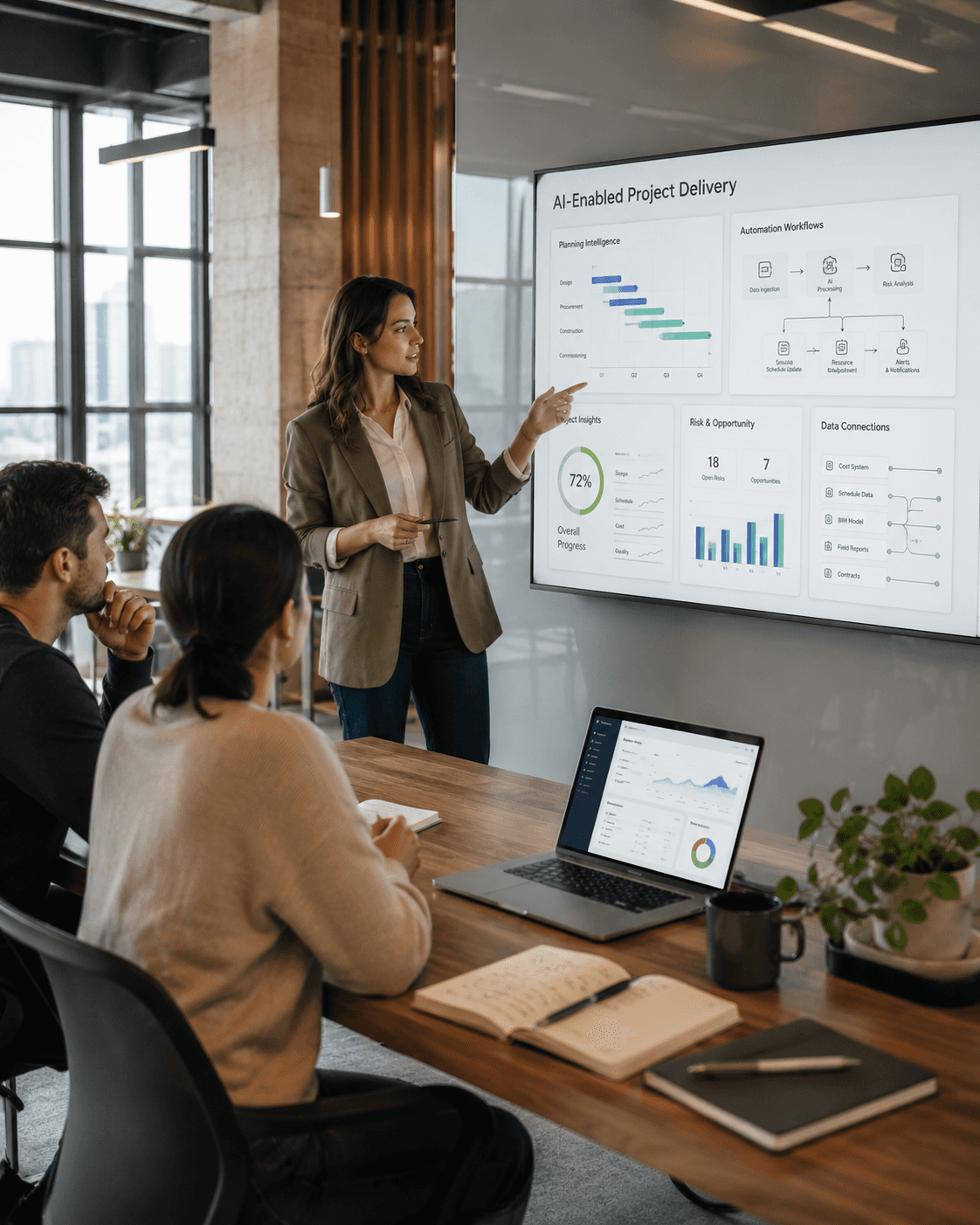
Project teams are starting to use AI across planning, reporting, commercial management, document review, risk analysis and operational workflows.
The change is not simply about introducing new software.
It is about changing how information moves through a project.
Traditional delivery environments rely heavily on people manually:
gathering information,
updating spreadsheets,
reviewing documents,
comparing systems,
producing reports,
writing narratives,
and identifying issues from large amounts of project data.
AI can increasingly support these activities at a much greater speed.
The result is a shift from teams spending time collecting information toward teams spending more time understanding and acting on it.
Project delivery has a data problem
Large projects already generate enormous amounts of information.
Programmes contain thousands of activities.
Commercial systems contain compensation events, change records and cost information.
Operational teams generate progress updates, constraints, actions and delivery records.
Suppliers continuously provide schedules, reports and supporting documentation.
The challenge is rarely the absence of data.
The challenge is turning that data into something useful.
Project teams frequently operate across:
Primavera P6,
Excel,
Power BI,
commercial systems,
document management platforms,
email,
meeting minutes,
and manually maintained trackers.
Important information exists across all of them.
But understanding the complete delivery position still requires significant human effort.
This is where AI can create substantial value.
AI can reduce the reporting burden
Reporting remains one of the most time-consuming activities across project controls.
Teams regularly spend large parts of reporting cycles:
extracting programme information,
updating dashboards,
checking progress,
preparing commentary,
reconciling different data sources,
and explaining movement from the previous period.
Much of this work is necessary.
But a significant proportion is repetitive.
AI can help automate the preparation and interpretation of this information.
Instead of manually reviewing hundreds or thousands of activities, systems can help identify:
significant schedule movement,
emerging delays,
float deterioration,
missed milestones,
unusual logic changes,
and areas requiring investigation.
The project controls professional still determines what the information means.
AI simply reduces the amount of manual work required to find it.
Planning becomes more analytical
Planning has traditionally depended heavily on individual planners interrogating complex schedules.
The quality of the output can therefore depend on:
available time,
individual experience,
reporting pressure,
and how thoroughly the programme can be reviewed.
AI can support planners by continuously analysing programme data for patterns that may otherwise take hours to identify manually.
This can include:
late predecessor relationships,
critical path movement,
excessive activity durations,
constraint usage,
logic instability,
float erosion,
and unusual programme changes.
The planner remains responsible for understanding the delivery context.
But instead of searching manually for every issue, they can begin with a clearer view of where investigation is required.
That changes the role from programme administration toward programme intelligence.
Risk visibility can become earlier
Major project problems rarely appear overnight.
They usually develop gradually.
A supplier begins slipping.
Float starts reducing.
Access restrictions increase.
Productivity weakens.
Commercial exposure grows.
Forecast dates begin moving.
In traditional reporting environments, these signals may exist across several separate systems and teams.
AI can help identify relationships between these signals earlier.
The value is not predicting the future with certainty.
It is improving the speed at which emerging deterioration becomes visible.
Earlier visibility gives project teams more options.
And on complex programmes, additional time to respond can be extremely valuable.
Commercial management can become more connected
Commercial teams also operate within increasingly complex information environments.
On NEC projects in particular, compensation events can generate large volumes of:
notifications,
assessments,
quotations,
programme impacts,
supporting evidence,
and contractual actions.
Managing this information manually becomes difficult as volumes increase.
AI can help teams organise, interrogate and connect commercial information with programme and delivery data.
This can improve visibility across:
outstanding actions,
commercial exposure,
programme impacts,
approaching deadlines,
supporting evidence,
and events requiring immediate attention.
The objective is not replacing commercial judgement.
It is making sure commercial professionals can apply that judgement to the right issues earlier.
AI changes how teams interact with project information
One of the most important changes may be how project teams access information.
Traditional systems require users to know:
where the information is stored,
how the system works,
what report to run,
and how to interpret the output.
AI creates the possibility of a different interaction.
Instead of navigating through multiple systems, project teams can increasingly ask direct questions such as:
What changed in the programme this week?
Which milestones are most at risk?
Where has float deteriorated?
Which compensation events require action?
What is driving the current completion forecast?
Which suppliers are showing signs of deterioration?
The complexity remains underneath.
But the interface between people and project data becomes significantly simpler.
The biggest opportunity is connecting project functions
AI becomes more powerful when it moves beyond isolated tasks.
Automating a report saves time.
Automating a spreadsheet saves time.
Generating meeting notes saves time.
But the larger opportunity is connecting information across the delivery environment.
Project controls may identify schedule deterioration.
Operations may understand the physical reason.
Commercial teams may understand the contractual exposure.
Leadership may need to understand the business impact.
When these functions operate independently, important relationships can be missed.
AI can help bring those relationships together.
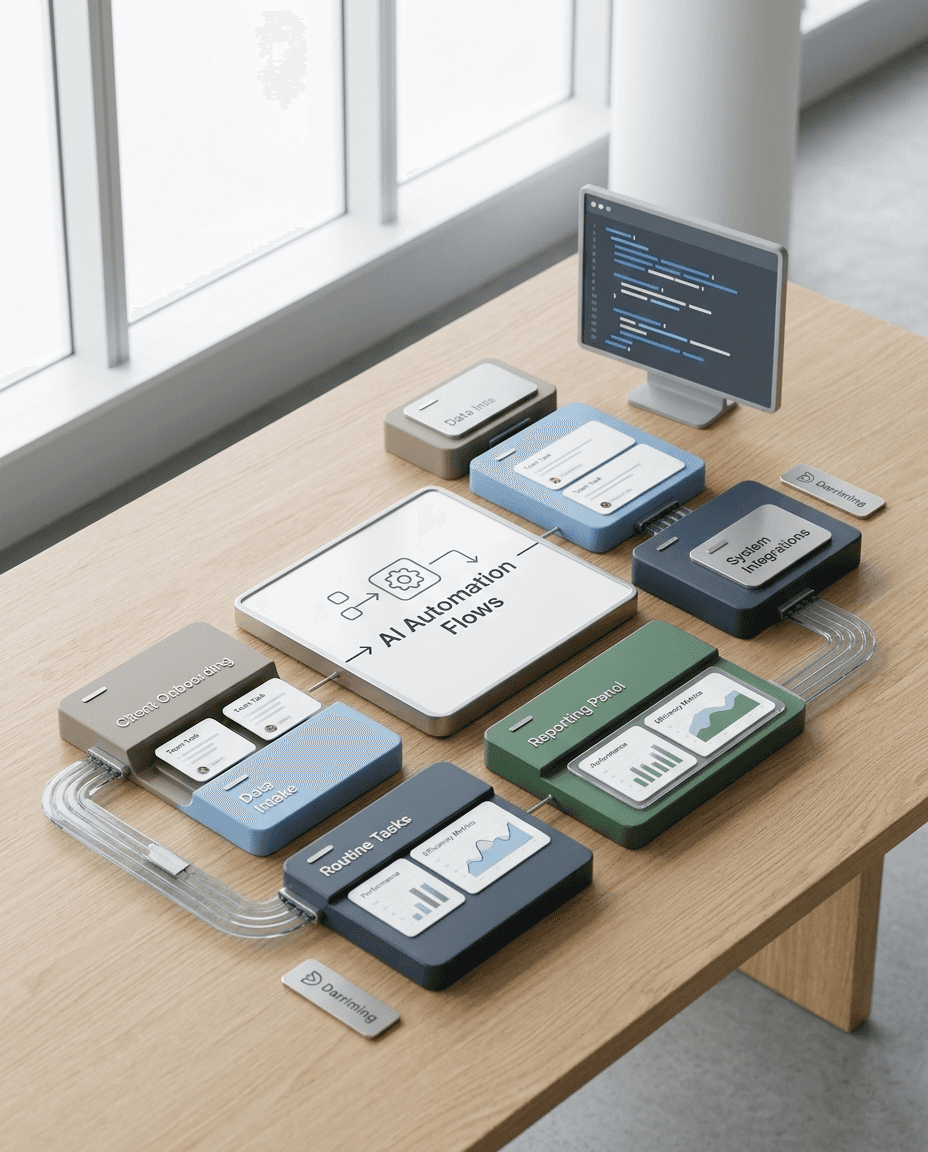
That creates the potential for connected project intelligence rather than isolated automation.
AI will change project roles rather than remove them
Project delivery remains highly dependent on professional judgement.
A programme does not explain why a sequence has changed.
A commercial register does not determine whether an entitlement is commercially strong.
A dashboard does not understand the practical constraints affecting delivery.
People provide that context.
AI is therefore more useful when it strengthens experienced professionals rather than attempts to replace them.
The likely shift is toward roles where people spend less time:
gathering data,
maintaining trackers,
producing repetitive reports,
and manually searching for information.
And more time:
analysing,
challenging,
coordinating,
forecasting,
advising,
and making decisions.
For project professionals, this changes where value is created.
The organisations that adapt first will operate differently
The biggest difference between organisations may not be whether they use AI.
It may be how deeply they integrate it into their operating model.
Adding an AI assistant alongside existing processes can create some efficiency.
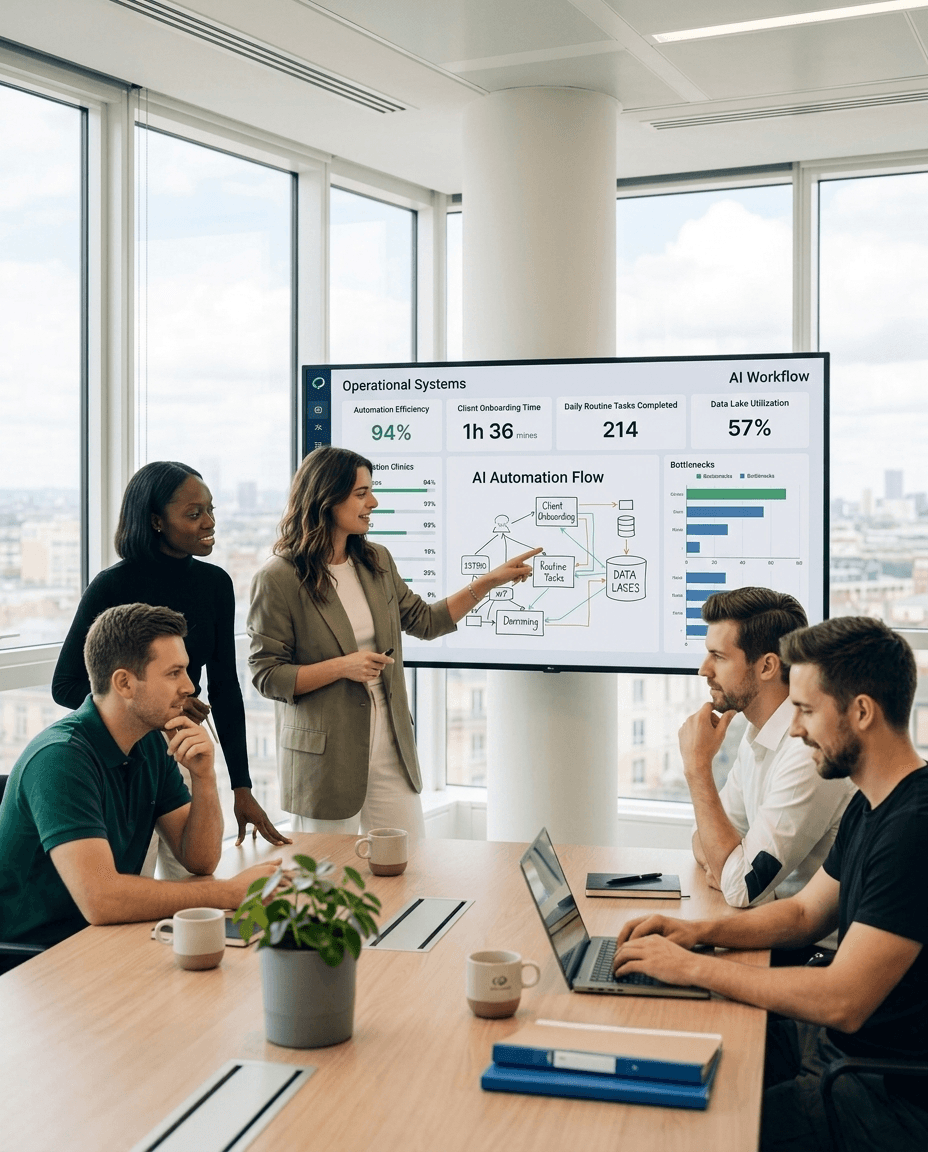
Redesigning workflows around AI can create significantly more.
That could mean:
automated programme analysis,
connected commercial intelligence,
AI-supported reporting,
integrated operational data,
automated workflow management,
and faster access to project knowledge.
The organisations that develop these capabilities will be able to operate with different levels of speed, visibility and efficiency.
This creates a growing gap between teams that simply use AI tools and teams that redesign project delivery around them.
The objective is better delivery, not more technology
There is a risk that AI becomes another technology initiative.
Project teams do not need more software simply because AI is available.
Any implementation still needs to solve a real delivery problem.
The most valuable applications are likely to be those that:
remove repetitive work,
improve information quality,
identify issues earlier,
connect fragmented systems,
strengthen decision-making,
and help teams deliver more effectively.
Technology is only useful when it improves the underlying delivery environment.
The objective should therefore never be AI adoption for its own sake.
The objective is better project delivery.
Conclusion
AI is beginning to change the way complex projects are planned, controlled and managed.
Its immediate value comes from reducing manual work, improving analysis and making project information easier to understand.
Its larger potential comes from connecting the fragmented information that already exists across planning, operations, commercial management and reporting.
The strongest project teams will not use AI to replace experienced professionals.
They will use it to give those professionals better information, earlier visibility and more time to focus on the decisions that matter.
That is where AI begins to move from a productivity tool to a fundamental part of modern project delivery.