PROJECT DELIVERY
Practical Ways AI Improves Project Delivery
AI can reduce manual project controls work, analyse information faster and help teams focus their attention where it matters most.

Author
Jake Barclay

AI creates value when it solves real project problems
AI is often discussed in broad terms.
Organisations hear about transformation, intelligent systems and automation, but the practical question for project teams is much simpler.
What can AI actually improve today?
Across project delivery, some of the strongest applications are already relatively straightforward.
AI can help teams:
analyse programme data,
prepare reporting,
review documents,
identify emerging risks,
interrogate commercial information,
automate repetitive workflows,
and access project knowledge more quickly.
The value comes from applying AI to processes that already consume significant time or create delivery risk.
The objective is not to introduce AI everywhere.
It is to use it where it improves how projects are controlled and delivered.
AI can accelerate programme analysis
Complex programmes can contain thousands of activities, relationships, constraints and milestones.
Reviewing this information manually takes time.
AI-supported analysis can help planners identify areas that require attention more quickly.
This can include:
activities that have moved significantly,
critical path changes,
deteriorating float,
late predecessors,
unusual durations,
constraint changes,
missed milestones,
and forecast movement.
Instead of manually searching through the programme, planners can begin with a structured view of potential issues.
The planner still determines whether those issues are important.
AI simply reduces the time required to find them.
Reporting can become faster and more focused
Project reporting often requires significant manual preparation.
Teams may spend hours:
gathering data,
comparing reporting periods,
updating dashboards,
preparing narrative,
checking inconsistencies,
and consolidating information from multiple sources.
AI can support much of this preparation.
For example, it can help identify significant changes between reporting periods and generate an initial structured summary of what has moved.
The project team can then review, validate and add the delivery context.
This creates a more efficient reporting process.
Instead of spending most of the reporting cycle producing information, teams can spend more time understanding it.
AI can help identify emerging delivery risks
Many project problems develop gradually.
A milestone moves slightly.
Float begins reducing.
A supplier starts missing planned dates.
Progress falls behind expectation.
Actions remain unresolved.
Commercial events begin accumulating.
Individually, these signals may not appear significant.
Together, they can indicate deterioration.
AI can help analyse larger quantities of project information and identify patterns that deserve investigation.
This gives teams the opportunity to intervene earlier.
The purpose is not to predict every project failure.
It is to improve visibility of the signals that may indicate one is developing.
Commercial teams can manage large volumes of change more effectively
Commercial environments can become difficult to control when projects generate large amounts of change.
On NEC projects, teams may be managing:
compensation events,
early warnings,
quotations,
assessments,
programme impacts,
contractual deadlines,
and supporting evidence.
When volumes increase, maintaining complete visibility manually becomes difficult.
AI can help teams organise and interrogate this information.
It can support identification of:
unresolved events,
overdue actions,
approaching deadlines,
high-value exposure,
missing evidence,
and events requiring immediate attention.
Combined with programme data, this can also improve visibility of how commercial change relates to actual delivery impacts.
AI can make project information easier to access
Finding information on major projects can be unnecessarily difficult.
Relevant information may sit across:
project management systems,
document repositories,
programme files,
commercial platforms,
spreadsheets,
reports,
emails,
and meeting records.
People often know the information exists.
The problem is finding it quickly.
AI can make this information easier to interrogate through natural language.
Instead of searching manually through multiple systems, a user could ask questions such as:
What changed in the programme this week?
Which milestones are currently at risk?
What is driving the completion forecast?
Which commercial actions are overdue?
What decisions were made about this issue?
Which supplier is showing the greatest deterioration?
This can significantly reduce the time required to navigate complex project information.
Document review can become more efficient
Major projects generate huge volumes of documentation.
Project teams may need to review:
contractor submissions,
reports,
technical documents,
meeting minutes,
contractual correspondence,
commercial records,
and supplier updates.
AI can assist by:
summarising documents,
extracting key information,
identifying actions,
comparing revisions,
classifying records,
and highlighting relevant clauses or references.
This can reduce the time spent on initial document review.
The professional still needs to validate the output and determine what action should be taken.
But they can start from a more focused position.
Meeting outputs can become easier to manage
Meetings generate large amounts of project information.
Actions are agreed.
Risks are discussed.
Decisions are made.
Responsibilities are assigned.
But the value of those meetings can be lost if information is not captured and followed through properly.
AI can help convert meeting information into structured outputs.
This can include:
summaries,
decisions,
actions,
owners,
due dates,
and key delivery issues.
Those actions can then feed into wider project workflows.
This reduces administrative effort while improving traceability.
AI can improve progress reporting
Progress reporting frequently depends on manual updates from multiple teams.
Information may arrive in different formats and with different levels of detail.
AI can help structure this information.
For example, written progress updates could be analysed and organised into consistent categories.
Potential inconsistencies could be identified.
Missing information could be highlighted.
Updates could be compared against planned activity.
This makes it easier for planners and project managers to understand the delivery position without manually processing every update individually.
Quality assurance can become more consistent
Project assurance often relies on people repeatedly applying the same checks.
A planner may review schedule quality.
A project controls team may inspect reporting data.
A commercial team may check whether records are complete.
AI and automation can help apply these checks consistently.
For programme data, this might include identifying:
missing logic,
excessive constraints,
unusually long activities,
negative float,
incomplete coding,
inconsistent progress,
and unusual schedule movement.
The findings can then be presented to the relevant professional for review.
This creates a repeatable assurance process rather than depending entirely on manual inspection.
AI can reduce repetitive spreadsheet work
Spreadsheets remain central to project delivery.
They are flexible and familiar, but many spreadsheet workflows require significant manual effort.
Teams frequently:
copy information,
update formulas,
reconcile datasets,
clean data,
prepare charts,
and repeat the same calculations every reporting cycle.
AI can support these activities by helping teams:
structure data,
identify inconsistencies,
create formulas,
analyse trends,
generate summaries,
and automate repetitive manipulation.
The objective is not necessarily to remove spreadsheets.
It is to reduce the manual effort required to maintain them.
Forecasting can become more informed
Forecasting depends on understanding both current performance and emerging trends.
Traditional forecasting can be limited by the amount of information a team can realistically review.
AI can help analyse larger datasets and highlight trends that may influence future performance.
This could include:
repeated supplier slippage,
declining productivity,
milestone movement,
increasing commercial exposure,
worsening float,
or recurring operational constraints.
These signals can support professional forecasting.
AI should not replace the judgement required to produce a credible forecast.
But it can provide more information on which that judgement is based.
Project knowledge can become easier to retain
Knowledge loss is a significant issue on long-running programmes.
People move between projects.
Teams change.
Key decisions may have been made months or years earlier.
Important context can become buried within documentation and correspondence.
AI can help organisations make historical project information easier to access.
Teams can search across approved project knowledge and retrieve relevant information around:
previous decisions,
lessons learned,
historical issues,
commercial events,
technical discussions,
and delivery outcomes.
This reduces dependence on individual memory.
It can also improve continuity when people join or leave a project.
AI can support more efficient workflows
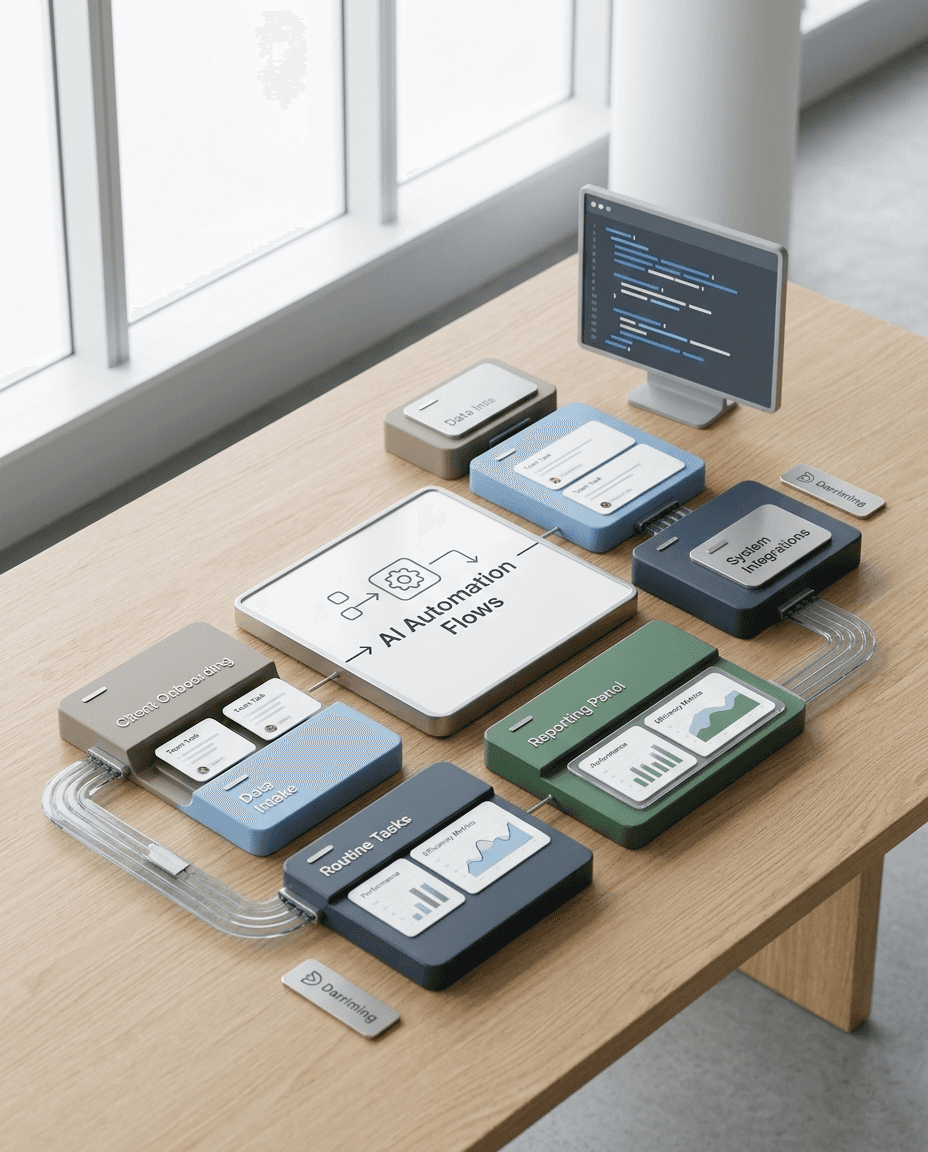
The strongest applications often combine AI with automation.
AI can interpret information.
Automation can then move that information through a defined process.
For example, a workflow could:
review a progress submission,
extract key information,
identify missing updates,
route issues to the correct person,
update a tracker,
and notify the project team.
The individual technologies are useful.
Connected together, they can remove entire layers of repetitive administration.
This is where AI begins to influence how projects operate rather than simply helping individuals complete isolated tasks.
Teams can spend more time on professional judgement
The most important benefit is capacity.
Experienced project professionals are valuable because of their ability to:
understand delivery context,
challenge assumptions,
coordinate teams,
interpret information,
develop solutions,
and make decisions.
They create less value when large parts of their day are spent:
copying data,
preparing repetitive reports,
searching for documents,
updating trackers,
and performing routine checks.
AI can reduce this administrative workload.
That allows organisations to use specialist experience where it has the greatest impact.
AI should support people, not bypass them
Project delivery carries significant commercial, operational and contractual consequences.
AI outputs therefore need appropriate human review.
A system may identify a schedule anomaly.
A planner needs to determine whether it matters.
AI may summarise a commercial event.
A commercial professional needs to assess the contractual position.
A workflow may identify a risk.
A project manager needs to determine the response.
AI works best when it improves the information available to professionals.
Accountability and judgement remain with the people responsible for delivery.
Start with the processes causing the most friction
Organisations do not need to transform every project process at once.
The most practical starting point is identifying where teams are already losing time.
Look for processes where people regularly say:
this takes hours every week,
we manually copy this information,
this report takes too long to prepare,
nobody knows which version is correct,
we have to check these individually,
or we identify these problems too late.
These are strong candidates for AI and automation.
Starting with clear problems also makes it easier to measure whether the technology is actually improving delivery.
The real measure is project performance
AI adoption should not be measured by how many tools an organisation deploys.
It should be measured by outcomes.
Useful questions include:
Has reporting become faster?
Are issues being identified earlier?
Has manual workload reduced?
Is project information more reliable?
Are teams making decisions faster?
Has commercial visibility improved?
Are experienced people spending more time on delivery?
If the answer is no, introducing AI has achieved very little.
Technology only creates value when it improves the underlying project environment.
Conclusion
AI can improve project delivery in practical ways today.
It can accelerate programme analysis, reduce reporting effort, support commercial management, improve document review, identify emerging risks and make project information easier to access.
The strongest use cases are not necessarily the most complicated.
They are the ones that remove real friction from existing project processes.
Used properly, AI gives project teams faster access to information, more consistent analysis and greater capacity to focus on delivery.
The objective is not to make projects more technological.
It is to make project teams more effective.